

Elevated Motorway
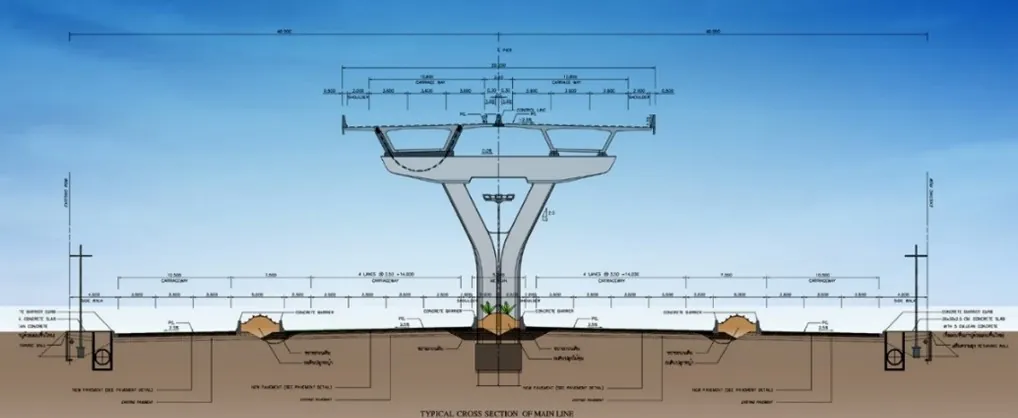
The Utraphimuk Elevated Tollway Extension Intercity Motorway, Rangsit – Bang Pa-In Section, Project (M5) involves an elevated motorway constructed along the central median of Highway 1 (Phahonyothin Road). It consists of 3 lanes in each direction, totaling 6. Each lane measures 3.50 m. wide, with left and right shoulders being 2.00 and 1.00 m. respectively. The parapet has a width of 0.425 m. and the median barrier 0.70 m., making a total of 28.55 m. The bridge structure consists of precast segmental box girders—one box girder per direction—supported by Y-shaped concrete piers.
Toll Collection System
An open system has been adopted for the project Toll Collection System, where tolls are paid at the on-ramp toll plaza at fixed rates based on vehicle categories, using a Multi-Lane Free Flow (M-Flow) System.
M-Flow System has been developed to create a single-platform toll collection network. It is applicable with all types of tollways no matter they are operated by the Expressway Authority of Thailand (EXAT), the DOH or other operators. Under this system, the private party will develop the Transaction Generation System to link with the DOH’s Central System (CS) while the DOH will be responsible for the CS operation, using single-platform system, including toll collection monitoring and administration.
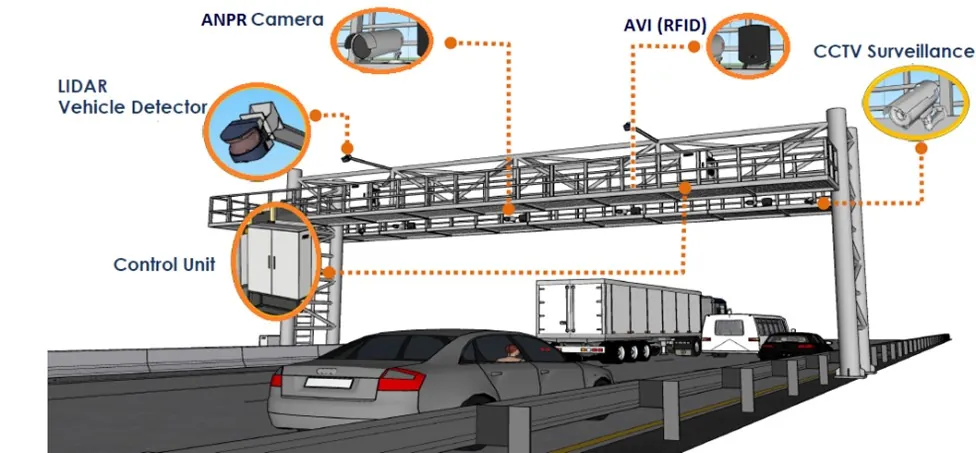
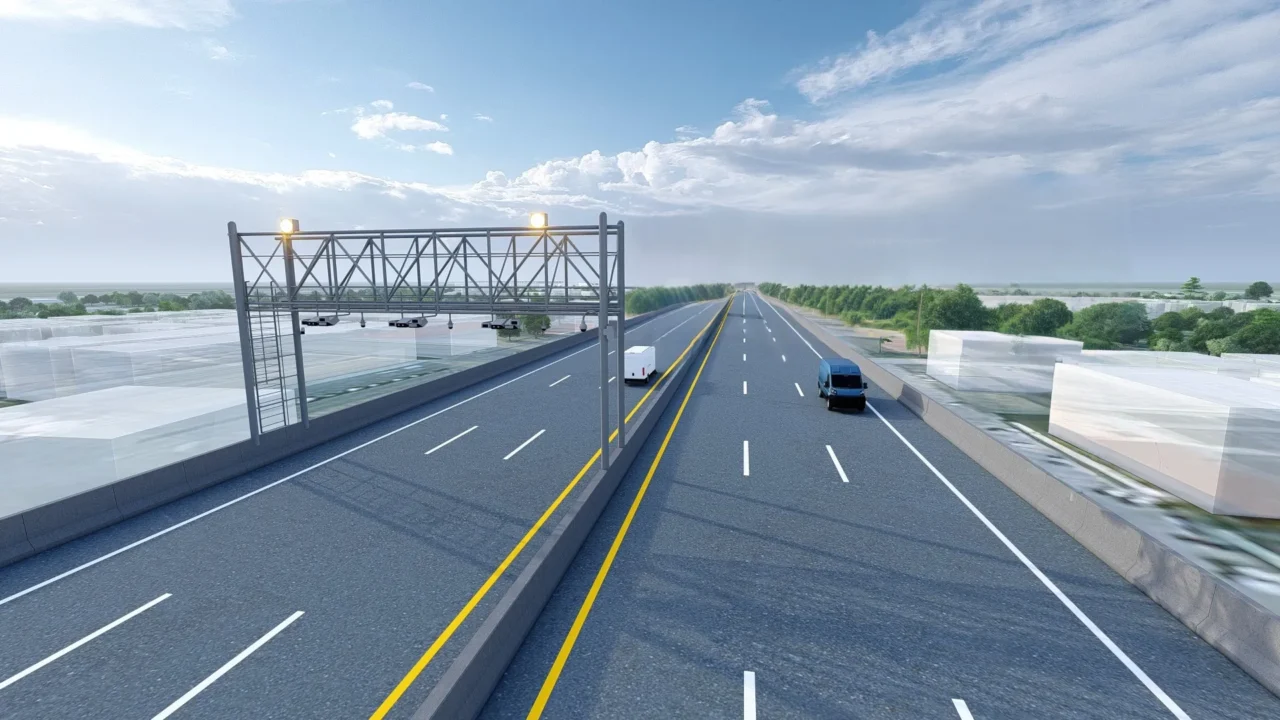
Example of M-Flow System Installation
Toll Payment
The Multi-Lane Free Flow (M-Flow) System uses Automatic License Plate Recognition (ALPR) technology to identify vehicles passing through toll plazas. Currently, both the toll monitoring system and the online toll payment system have been implemented. For those who are M-Flow members, tolls will be automatically deducted from their registered accounts. Non-M-Flow members are allowed to pass M-Flow lanes but required to pay tolls online, within the time stipulated.
Toll Collection System will transmit toll transaction data, including license plate numbers and details of the passage (date, time, location), along with toll amounts, to the M-Flow Single Platform System for processing and billing. Once the M-Flow System is adopted, the entire process will become fully automated with no staff required at toll plazas as all monitoring and control tasks of toll-collection equipment will be managed centrally.
Traffic Control Surveillance System
Traffic Control Surveillance System is designed to reduce the likelihood of accidents and improve traffic flow by coordinating and issuing commands from the Central Control Building (CCB) located in Soi Vibhavadi Rangsit 76, or from the local control building at each toll plaza, to various traffic control devices installed along the route, including:
- Advance Traffic Management System
- Traffic CCTV System
- Traffic Detection System
- Automatic Traffic Incident Detection System
- Variable Message Sign System
- Integrated Speed and Lane Use Sign System
- Automated Speed Enforcement System
- Power Supply for TSCS
- Data and Communication Network System
- Emergency Telephone System
- IP Telephone System
- Distributed Time System
- Radio Communication System
- Maintenance Online Management System (MOMS)
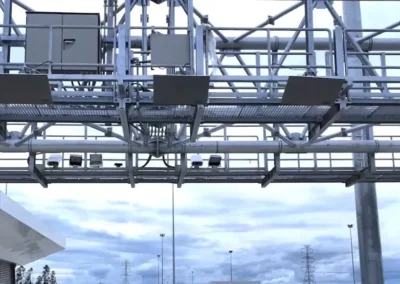
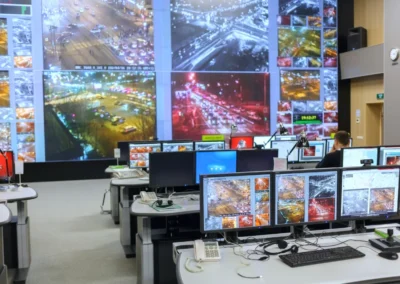
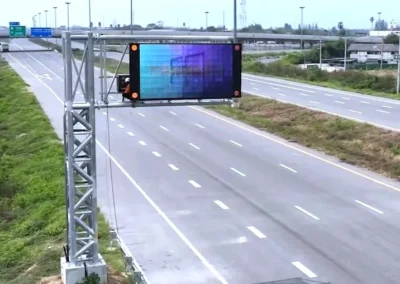
Example of Traffic Control Surveillance System
